Last Updated: February 2026
Introduction
In nature, organisms rarely live in isolation. Many species interact closely with one another, forming relationships that influence survival, growth, and reproduction. One such important relationship is mutualism, where both interacting organisms benefit.
Mutualism is a key concept in ecology and biology, helping explain how species coexist and evolve together. This article explains the definition of mutualism, its types, and real-life examples, making the concept easy to understand for students and general readers.
What is Mutualism?
Mutualism is a type of symbiotic relationship in which both organisms involved benefit from the interaction.
Simple definition:
Mutualism is a biological interaction between two different species where both gain benefits.
This relationship can occur between plants and animals, microorganisms and hosts, or even between two microorganisms.
Characteristics of Mutualism
Mutualistic relationships share the following features:
- Both species gain benefits
- Interaction may be obligatory or facultative
- Improves survival, nutrition, or reproduction
- Common in terrestrial and aquatic ecosystems
Types of Mutualism
Mutualism can be classified into different types based on the nature of interaction.
| Type | Definition | Example |
|---|---|---|
| Obligate mutualism | Partners depend completely on each other | Lichen (algae & fungi) |
| Facultative mutualism | Benefits but not required | Bees & flowers |
| Trophic mutualism | Nutritional exchange | Gut bacteria & humans |
1. Obligate Mutualism
In obligate mutualism, both organisms depend on each other for survival. Without the partner, neither can complete its life cycle.
Example:
- Lichens (algae + fungi)
- Algae provide food through photosynthesis
- Fungi provide protection and moisture
Neither organism can survive independently in natural conditions.
2. Facultative Mutualism
In facultative mutualism, the interaction is beneficial but not essential for survival.
Example:
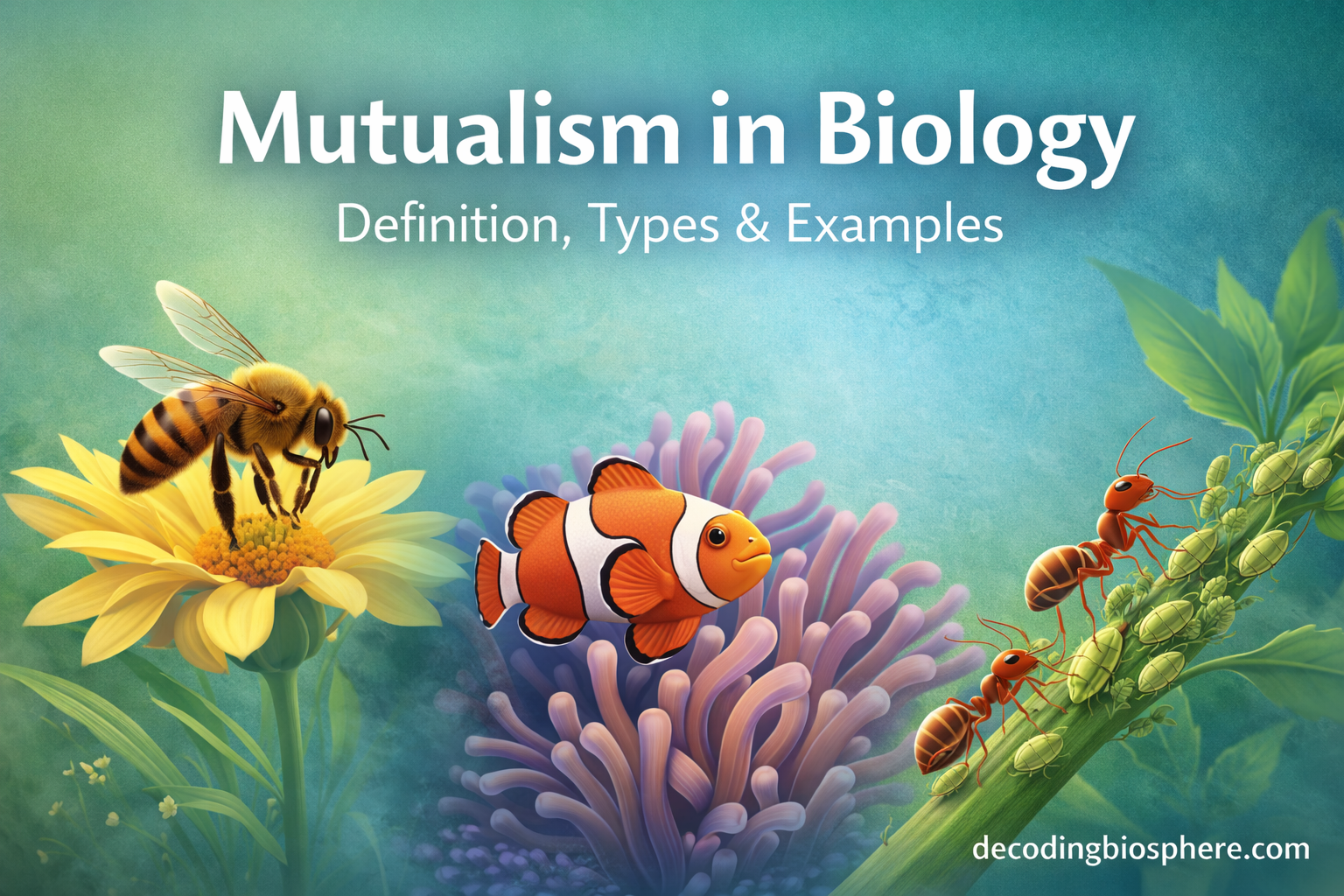
- Bees and flowering plants
- Bees get nectar as food
- Plants get pollinated
Both can survive independently but perform better together.
3. Trophic Mutualism
This type involves nutritional exchange between species.
Example:
- Humans and gut bacteria
- Bacteria receive shelter and nutrients
- Humans benefit from digestion and vitamin synthesis
4. Defensive Mutualism
One species provides protection, while the other offers food or shelter.
Example:
- Ants and aphids
- Aphids produce honeydew for ants
- Ants protect aphids from predators
Examples of Mutualism in Nature
| Organism A | Organism B | Mutual Benefit |
|---|---|---|
| Bee | Flower | Pollination & nectar |
| Algae | Fungus | Food & protection |
| Clownfish | Sea anemone | Shelter & cleaning |
| Termites | Gut protozoa | Digestion of cellulose |
Importance of Mutualism
Mutualism plays a vital role in ecosystems by:
- Enhancing nutrient cycling
- Increasing species survival
- Supporting food webs
- Promoting co-evolution
- Maintaining ecological balance
Many ecosystems would collapse without mutualistic interactions.
Mutualism vs Other Symbiotic Relationships
Mutualism is one of the three main types of symbiosis:
- Mutualism – both organisms benefit
- Commensalism – one benefits, the other is unaffected
- Parasitism – one benefits, the other is harmed
| Interaction | Benefit to Species A | Benefit to Species B |
|---|---|---|
| Mutualism | Yes | Yes |
| Commensalism | Yes | No effect |
| Parasitism | Yes | Harm |
Understanding mutualism helps in clearly distinguishing it from other biological associations. It is also essential while studying types of symbiosis in biology, especially for ecology and environmental science students.
Real-World Applications of Mutualism
- Agriculture: Pollinators improve crop yields
- Medicine: Gut microbiota support human health
- Environmental conservation: Protecting keystone mutualistic species maintains ecosystems
Conclusion
Mutualism is a fundamental ecological interaction where both organisms gain advantages. From pollination to digestion and protection, mutualistic relationships shape biodiversity and ecosystem stability. Studying mutualism helps us understand how life on Earth is interconnected and interdependent.
Interested in more environmental science concepts? Do check out our other articles by visiting the Environmental Dictionary
Related Biological Interactions
Keystone Species: Definition and Examples
Biological Association: Types and Examples
Frequently Asked Questions (FAQs)
Q1. What is mutualism in biology?
Mutualism is a type of symbiotic relationship in which both interacting species benefit from the association.
Q2. What are common examples of mutualism?
Examples include bees and flowers, algae and fungi in lichens, ants and aphids, and humans with gut bacteria.
Q3. Is mutualism always necessary for survival?
No. Mutualism can be obligate (essential for survival) or facultative (beneficial but not essential).
Q4. How is mutualism different from commensalism?
In mutualism, both organisms benefit, whereas in commensalism, one benefits and the other is neither helped nor harmed.
Q5. Why is mutualism important in ecosystems?
Mutualism supports biodiversity, enhances nutrient cycling, improves species survival, and maintains ecological balance.
MCQs on Mutualism in Biology
1. Mutualism is best defined as a relationship in which:
a) One organism benefits and the other is harmed
b) Both organisms benefit from the interaction
c) One organism benefits and the other is unaffected
d) Both organisms are harmed
Answer: b) Both organisms benefit from the interaction
2. Which of the following is an example of mutualism?
a) Lion and zebra
b) Tapeworm and human
c) Bee and flowering plant
d) Orchid growing on a mango tree
Answer: c) Bee and flowering plant
3. Lichens represent a mutualistic association between:
a) Algae and fungi
b) Bacteria and fungi
c) Fungi and mosses
d) Algae and bacteria
Answer: a) Algae and fungi
4. In a mutualistic relationship between leguminous plants and Rhizobium bacteria:
a) The plant provides nitrogen to bacteria
b) Both organisms compete for nutrients
c) Bacteria fix atmospheric nitrogen for the plant
d) The bacteria harm the plant roots
Answer: c) Bacteria fix atmospheric nitrogen for the plant
5. Which type of mutualism is essential for the survival of both interacting species?
a) Facultative mutualism
b) Commensalism
c) Obligate mutualism
d) Parasitism
Answer: c) Obligate mutualism
6. Mutualism differs from commensalism because in mutualism:
a) Only one organism benefits
b) Both organisms benefit
c) One organism is harmed
d) Both organisms are unaffected
Answer: b) Both organisms benefit
7. The relationship between humans and gut bacteria is an example of:
a) Parasitism
b) Commensalism
c) Mutualism
d) Predation
Answer: c) Mutualism
8. Which of the following best explains the ecological importance of mutualism?
a) It increases competition between species
b) It disrupts ecosystem stability
c) It enhances survival and biodiversity
d) It limits species interactions
Answer: c) It enhances survival and biodiversity
9. Pollination is considered a mutualistic interaction because:
a) Plants trap insects for nutrition
b) Insects harm flowers while feeding
c) Both plants and pollinators benefit
d) Only plants benefit from insects
Answer: c) Both plants and pollinators benefit
10. Which of the following is NOT a mutualistic association?
a) Lichen
b) Mycorrhiza
c) Tapeworm in humans
d) Bee–flower interaction
Answer: c) Tapeworm in humans

 Decoding Biosphere