Biodiversity supports life on Earth — from providing food and clean air to regulating climate and sustaining ecosystems. But not all regions are equally rich in biological diversity. Some areas, called biodiversity hotspots, contain an extraordinary number of species found nowhere else on the planet — and yet many of these places are under severe threat.
Despite covering just 2.3% of Earth’s land surface, biodiversity hotspots support nearly half of the world’s plant species — making them conservation priorities of global importance.
In this article, we explain what biodiversity hotspots are, why they are important, where they are located, and what we can do to protect them.
🌿 What Is a Biodiversity Hotspot?
A biodiversity hotspot is a region that meets two strict criteria:
- It has at least 1,500 plant species found nowhere else on Earth (high endemism).
- It has lost at least 70% of its original natural habitat.
This concept was developed by conservation scientist Norman Myers to help prioritize areas for protection — places where urgent action saves the most species with limited resources.
👉 Read also: Importance of Biodiversity
👉 Symbiosis vs Other Biological Interactions
🌍 At-a-Glance: Biodiversity Hotspot Facts
Here is a quick overview of biodiversity hotspot statistics:
| Feature | Details |
|---|---|
| Total hotspots globally | 36 recognized regions |
| Land area covered | ~2.3% of Earth’s land |
| Endemic plant species | >50% of all vascular plants |
| Vertebrate species | ~43% of all species |
| Main threats | Deforestation, pollution, climate change |
Biodiversity hotspots are relatively small in area but extremely rich in life, making them orders of magnitude more valuable for conservation per acre than other regions.
🧠 Why Biodiversity Hotspots Are Important
1️⃣ They Harbor Unique Species
Hotspots contain huge numbers of endemic species — organisms found nowhere else. Losing these areas would mean losing species forever.
2️⃣ They Support Ecosystem Services
Healthy ecosystems:
- Clean air and water
- Pollination of crops
- Soil formation
- Carbon sequestration
These services are fundamental to both nature and human societies.
3️⃣ They Buffer Against Climate Change
Many hotspots — like tropical forests and coral reefs — store massive amounts of carbon and help regulate global climate patterns.
4️⃣ They Are Key to Human Health
Medicinal plants, genetic resources, and disease regulation all trace back to biological diversity.
🐾 Major Examples of Biodiversity Hotspots
Here are some of the most famous and critical hotspots around the world:
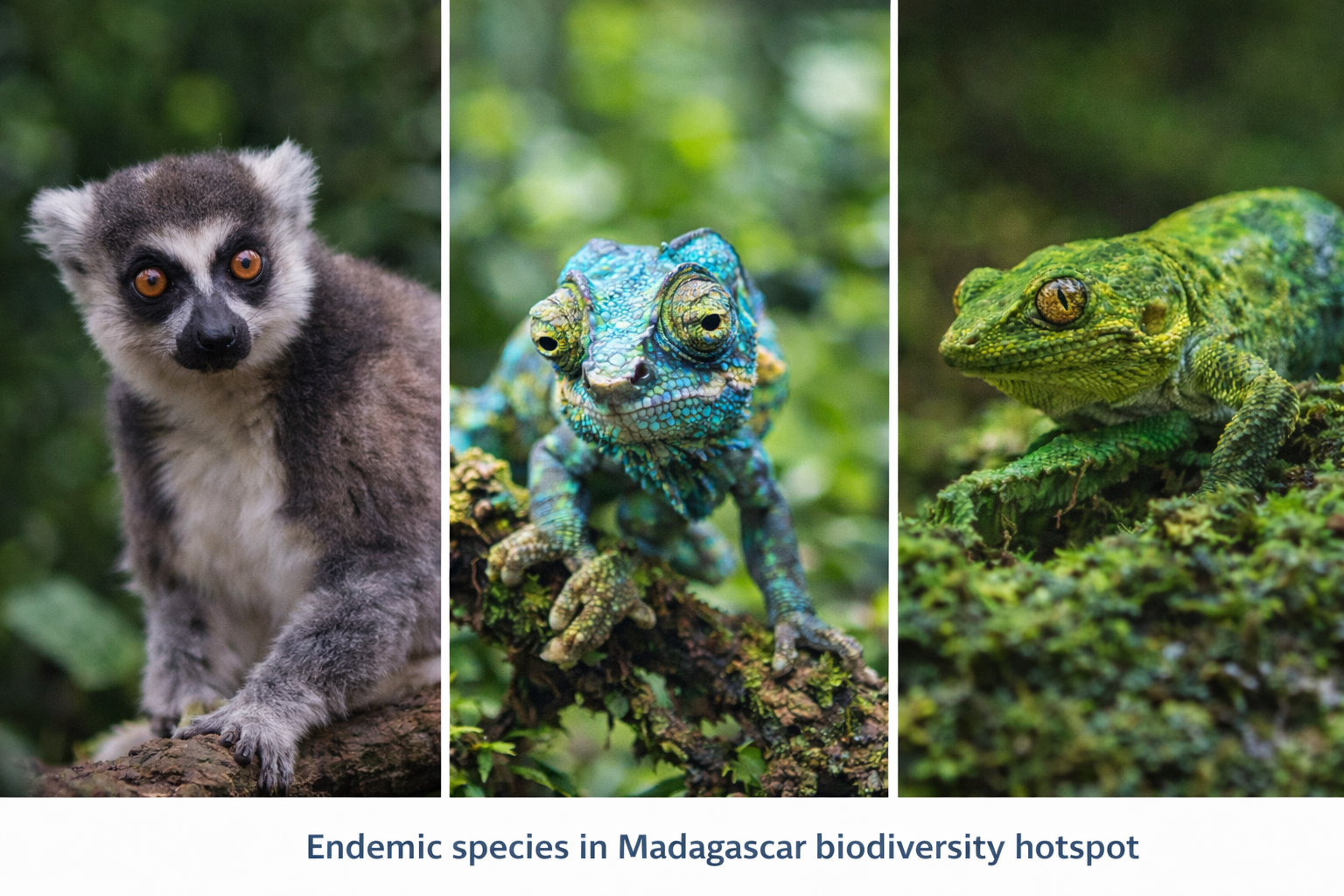
📍 1. Madagascar and the Indian Ocean Islands
- Unique wildlife → lemurs, chameleons, baobabs
- Major threat → habitat loss, invasive species
📍 2. Western Ghats (India)
- One of the richest regions for amphibians, reptiles, and plants
- Under pressure from development and agriculture
📍 3. Tropical Andes (South America)
- Highest concentration of plant species on Earth
- Threats → mining, deforestation
📍 4. Mesoamerica
- Central American forests and mountain ranges
- Contains thousands of endemic species
📍 5. Sundaland (Indonesia, Malaysia)
- Rainforests with gigantic tree diversity
- Threats → palm oil plantations
⚠️ What Threatens Biodiversity Hotspots?
| Threat | Impact |
|---|---|
| Deforestation | Habitat loss and fragmentation |
| Climate Change | Altered ecosystems, species range shifts |
| Pollution | Water and soil contamination |
| Overexploitation | Hunting, logging |
| Invasive Species | Native species displacement |
Each threat quickly erodes biodiversity hotspots because the endemic species are already rare and highly specialized.
🌱 How Can We Protect Hotspots?
Protecting biodiversity hotspots requires global cooperation and local action:
✔ Protected Areas & National Parks
Designating land as protected restricts harmful activities.
✔ Restoration Ecology
Replanting forests and rebuilding habitats helps recover biodiversity.
✔ Sustainable Resource Use
Protecting fisheries, forests, and soil ensures long-term ecosystem health.
✔ Policy & Education
Strong environmental laws and public awareness reduce destructive practices.
🔗 Related Ecology Concepts
- Importance of Biodiversity
- Habitat Fragmentation & Biodiversity Solutions
- Impact of Climate Change on Biodiversity
- Keystone Species: Definition & Examples
A biodiversity hotspot is a region that contains at least 1,500 endemic plant species and has lost at least 70% of its original habitat. These areas are identified as conservation priorities due to their exceptional biological richness and high levels of threat.
❓ Frequently Asked Questions (FAQs)
What defines a biodiversity hotspot?
A biodiversity hotspot is a region that contains at least 1,500 endemic plant species and has lost at least 70% of its original habitat. These areas are identified as conservation priorities due to their exceptional biological richness and high levels of threat.
How many biodiversity hotspots exist?
There are 36 recognized hotspots worldwide.
Why do biodiversity hotspots need protection?
They support unique animals and plants, ecosystem services, and human well-being, but are highly threatened.
Are hotspots only in tropical regions?
No — while many are tropical, some occur in temperate zones too (e.g., California Floristic Province).
Can biodiversity hotspots recover once degraded?
Yes — through restoration and conservation — but the process takes time and sustained effort.
🧠 Final Thoughts
Biodiversity hotspots are Earth’s richest reservoirs of life. Protecting them isn’t just about saving pretty places — it’s about preserving the foundations of life, climate stability, and human health.
Every policy choice, conservation effort, and individual action contributes to securing these irreplaceable ecosystems.
MCQs on Biodiversity Hotspots
- What are biodiversity hotspots?
- a) Areas with extremely high temperatures
- b) Regions with high species diversity and significant threats
- c) Locations with active volcanic activity
- d) Protected areas designated for wildlife conservation
- How much of Earth’s land surface do biodiversity hotspots cover?
- a) Approximately 50%
- b) Around 2%
- c) About 5%
- d) Around 20%
- Which of the following is true about biodiversity hotspots?
- a) They are found evenly distributed across the globe.
- b) They only exist in tropical rainforests.
- c) They provide minimal ecosystem services.
- d) They are characterized by high species diversity and habitat threats.
- Biodiversity hotspots contribute to ecological balance by:
- a) Reducing the number of species in an ecosystem.
- b) Disrupting natural ecological processes.
- c) Enhancing the stability and resilience of ecosystems.
- d) Isolating species from their natural habitats.
- What percentage of the world’s plant species is estimated to be found in biodiversity hotspots?
- a) Less than 10%
- b) Approximately 25%
- c) About 50%
- d) Over 75%
- One of the significant benefits of preserving biodiversity hotspots is:
- a) Expanding urban development in these regions.
- b) Reducing the need for conservation efforts.
- c) Ensuring the survival of endangered species.
- d) Minimizing the importance of ecosystem services.
- Biodiversity hotspots play a role in mitigating climate change by:
- a) Emitting large amounts of greenhouse gases.
- b) Promoting deforestation.
- c) Acting as natural carbon sinks.
- d) Accelerating the rate of species extinction.
- Which of the following is a characteristic of species found in biodiversity hotspots?
- a) They are non-endemic species.
- b) They are not threatened by habitat loss.
- c) They have a limited range of distribution.
- d) They are resistant to climate change.
- How can scientific research benefit from studying biodiversity hotspots?
- a) By finding solutions to eliminate biodiversity hotspots.
- b) By developing methods to reduce species diversity.
- c) By unraveling species interactions and evolutionary processes.
- d) By creating artificial habitats for endangered species.
- What role do biodiversity hotspots play in sustaining local communities?
- a) They provide unlimited resources for exploitation.
- b) They have no impact on local livelihoods.
- c) They offer essential ecosystem services and resources.
- d) They increase poverty and environmental degradation.
Answers:
- b) Regions with high species diversity and significant threats
- b) Around 2%
- d) They are characterized by high species diversity and habitat threats.
- c) Enhancing the stability and resilience of ecosystems.
- c) About 50%
- c) Ensuring the survival of endangered species.
- c) Acting as natural carbon sinks.
- c) They have a limited range of distribution.
- c) By unraveling species interactions and evolutionary processes.
- c) They offer essential ecosystem services and resources.

 Decoding Biosphere