In an age when even reading leaves a digital footprint, the question isn’t whether to read – it’s how. Both e-books and audiobooks promise convenience and waste reduction compared to print, but which one truly stands greener when we look at energy, devices, and long-term impact?
1. Understanding the Environmental Footprint of Reading
Traditional printed books, while tangible and cherished, come with an unavoidable environmental cost. According to the European Federation of Publishers (2023), producing one paperback releases approximately 7.5 kg of CO₂, factoring in paper manufacturing, ink, binding, transport, and returns.
E-books and audiobooks eliminate printing and shipping but introduce a new variable: digital infrastructure. Their sustainability depends on device lifespan, server energy, and user behavior.
2. The Case for E-books
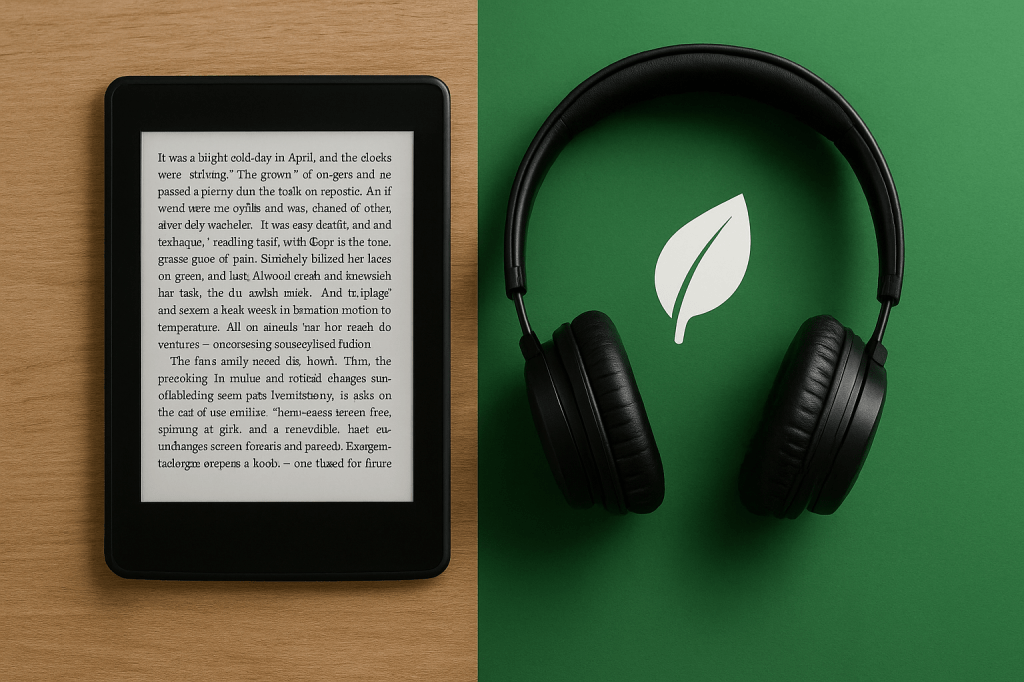
E-books revolutionized access to reading. A single e-reader like the Kindle Paperwhite can store thousands of titles, eliminating the need for physical production and transport.
Environmental advantages:
- No paper, ink, or packaging.
- Efficient data transfer as most e-book files are under 5 MB.
- Long device life (3–6 years average).
- E-ink screens use minimal power compared to LCD displays.
Environmental drawbacks:
- Device manufacturing involves rare metals and plastics.
- Charging still requires grid energy (though minimal).
- If devices are frequently replaced, the footprint rises sharply.
A Carnegie Mellon University (2022) study found that an e-reader becomes environmentally superior to printed books after reading about 25 titles, assuming a 3–4-year lifespan and responsible disposal.
Verdict: E-books are efficient for frequent readers and long-term learners, provided devices are used sustainably and recycled responsibly.
3. The Case for Audiobooks
Audiobooks have grown into a dominant medium, powered by platforms like Audible. Once produced and uploaded, a single audio file can be streamed by millions with only marginal energy cost per listener which an ideal model of dematerialization.
Environmental advantages:
- Zero physical materials after initial production.
- Compatible with existing devices as there is no need for dedicated hardware.
- Lower energy intensity per user once recorded.
- Encourages screen-free learning (reduced visual fatigue).
Environmental drawbacks:
- Initial recording and hosting consume energy.
- Streaming over mobile networks can increase per-use emissions versus downloading offline.
- Repeated streaming on cellular data adds up.
However, newer compression formats (e.g., AAC and Opus) and renewable-powered data centers have reduced the carbon load of streaming dramatically since 2020.
Verdict: Audiobooks excel in scalability and low incremental energy use, especially when downloaded and listened offline.
4. Comparing the Two: Life-Cycle Snapshot
| Factor | E-Books | Audiobooks |
|---|---|---|
| Material use | Requires e-reader (plastic, metals) | Uses existing phone/tablet |
| Energy to produce | Moderate (device manufacturing) | High initially (studio production), negligible later |
| Energy to use | Low (e-ink screen) | Low (playback, best offline) |
| Carbon per unit | ~2 kg CO₂ per 25 books (device amortized) | <0.1 kg CO₂ per 10 hours of playback |
| Recyclability | Depends on e-waste management | None needed (digital only) |
| Accessibility | Text-based | Audio-based, inclusive |
| Winner | Frequent readers | Multitaskers, inclusive learners |
5. The Human Factor: How We Learn and Retain
Eco-efficiency aside, how we learn matters. Reading e-books suits analytical learning like scanning, highlighting, revisiting concepts. Audiobooks enhance conceptual understanding and retention through tone and pacing.
For sustainability, behavior is as crucial as technology. A rarely used e-reader is less sustainable than a frequently used audiobook app. The greenest choice is the one that replaces resource-intensive alternatives and becomes a regular habit.
6. Practical Tips for Greener Digital Reading
- Download, don’t stream: Save your audiobook for offline listening to reduce network energy use.
- Extend device life: Keep your Kindle or phone longer; the environmental payback grows with time.
- Use dark or low-power modes: Reduces battery drain on tablets and phones.
- Recycle electronics responsibly: Many local e-waste centers and Amazon recycling programs take back old devices.
- Switch to renewable-powered services: Audible and Kindle operations increasingly use Amazon’s carbon-neutral servers.
7. So, Which Wins?
When viewed through the full life cycle, audiobooks have a slight edge for most listeners because they use devices people already own and consume less new hardware. E-books remain the better option for readers who need visual comprehension or research flexibility.
Both are far greener than printed books but the real question is how consciously we use them.
If sustainability means making the most of what you have, then listening to books you love may be the quietest form of climate action.
Ready to Try Sustainable Reading?
🎧 Explore Audible Free Trial : unlimited audiobooks for 30 days.
📚 Discover Kindle Unlimited : millions of e-books without printing a single page.
Learning sustainably begins with one mindful choice.
This post contains affiliate links. If you sign up or purchase through them, I may earn a small commission at no extra cost to you.


 Decoding Biosphere
A really nice comparison. I like the heuristic of 25 book titles pays off in the sustainability metrics in e-book vs real book.
However, the decision to choose rarely hinges on sustainability scores. A passionate reader is too emotionally connected to physical books to want to switch. From travel and convenience perspectives, e-book readers take over. Nevertheless, these comparisons help tilt the balance here or there, now and then!
LikeLike