🌍 What Is a Digital Carbon Footprint?
A digital carbon footprint refers to the total greenhouse gas emissions generated by our use of digital devices, internet services, data storage, and online platforms. Every email you send, video you stream, or file you store in the cloud consumes energy—most of which is still produced using fossil fuels.
In 2025, as our digital lives expand, it’s more important than ever to adopt eco-friendly tech habits that reduce this hidden but significant impact on the environment.
📊 Why Does It Matter in 2025?
- Data centers contribute to nearly 3% of global electricity consumption (IEA, 2024).
- An average user emits about 400 kg of CO₂ annually just through digital activity (GreenTech Alliance, 2025).
- Digital emissions are expected to surpass aviation emissions by 2026.
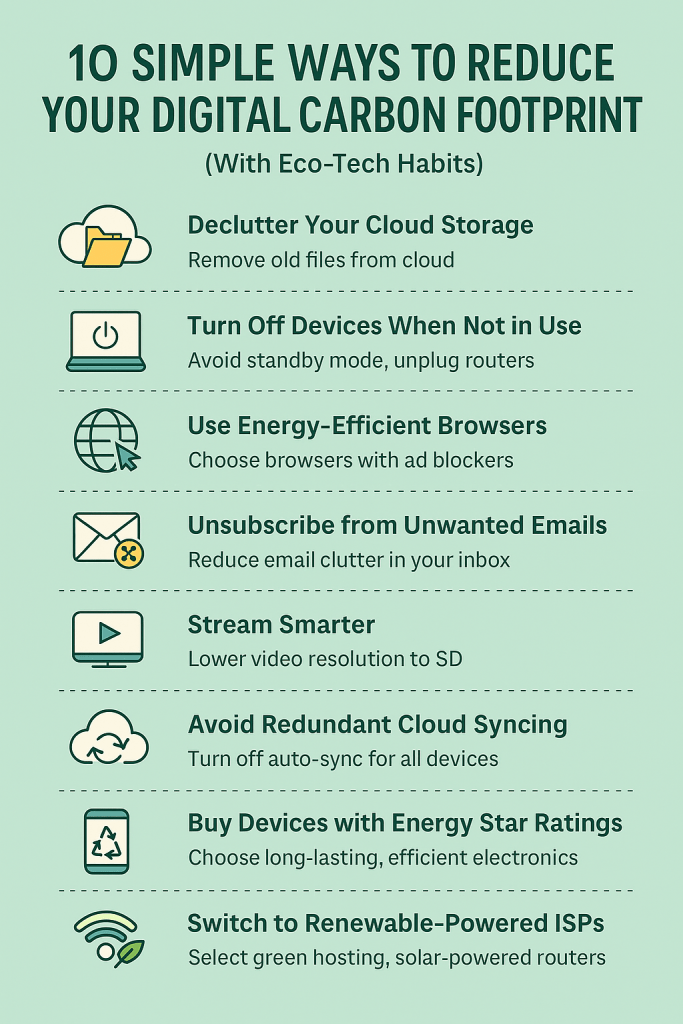
✅ 10 Simple Ways to Reduce Your Digital Carbon Footprint
1. 🧹 Declutter Your Cloud Storage
Every gigabyte stored on cloud servers consumes energy 24/7. Delete old emails, unused Google Drive or Dropbox files, and archive only what you need.
📌 Pro Tip: Use low-carbon cloud providers like Google Cloud, which runs on 100% renewable energy.
2. 🔌 Turn Off Devices When Not in Use
Always shut down laptops, monitors, routers, and printers instead of leaving them in standby mode.
💡 Idle electronics still draw power (phantom load), accounting for up to 10% of household energy use.
3. 🌐 Use Energy-Efficient Browsers and Settings
Switch to browsers like Firefox or Brave with built-in trackers/ad blockers to reduce unnecessary data loading.
🖥️ Dark mode can reduce screen power usage by up to 30% on OLED displays.
4. 📧 Unsubscribe from Unwanted Emails
A single email emits between 4 to 50 grams of CO₂, depending on attachments and servers.
💥 Unsubscribing from 100 unwanted newsletters = saving energy equivalent to driving 1 km!
5. 🎥 Stream Smarter
Streaming in HD or 4K consumes significantly more data. Lower resolution when video quality isn’t essential.
🧮 Streaming in SD saves ~90% energy compared to 4K.
6. ☁️ Avoid Redundant Cloud Syncing
Do you really need your entire gallery synced to every device? Optimize auto-sync settings and reduce data duplication.
7. 🔋 Buy Devices with Energy Star Ratings
Choose laptops, phones, and routers that are energy-efficient and have longer life cycles.
🔄 Longer lifespan = fewer emissions from manufacturing and e-waste.
8. ♻️ Recycle or Donate Old Electronics
E-waste contributes to toxic pollution and wasted energy. Use certified e-waste collection centers or donate working gadgets.
9. 📶 Switch to Renewable-Powered ISPs (Where Possible)
Some ISPs and cloud providers now offer green hosting and renewable-powered infrastructure.
🏢 Ask your provider if they use green energy or offset emissions.
10. 💬 Spread Awareness
Share your habits on social media or start a digital sustainability challenge in your community.
👨👩👧👦 Small changes scale fast when more people join in.
📉 Your Personal Digital Footprint Calculator
Try this quick formula to estimate your digital carbon footprint:
- 1 hour video streaming (HD) = 0.4 kg CO₂
- 1 email sent (with attachment) = 50g CO₂
- 1 hour on social media = 0.1 kg CO₂
🧮 Multiply by your daily habits and track your progress weekly.
Coming soon: Our free downloadable Digital Footprint Tracker!
🙋♀️ Frequently Asked Questions (FAQs)
❓ What is the biggest source of digital emissions?
Streaming video, cloud storage, and large-scale AI models are among the top contributors.
❓ Does using Wi-Fi or mobile data emit more CO₂?
Mobile networks are generally more carbon-intensive than Wi-Fi.
❓ Is deleting emails really effective?
Yes—email servers run on massive data centers. Less storage = less power consumed.
📢 Final Thoughts
We often focus on physical pollution, but our invisible digital habits matter too. With a few mindful tweaks, you can significantly reduce your carbon footprint in 2025—without giving up technology.
💬 Which habit will you adopt today? Share in the comments below!
Pin it


 Decoding Biosphere