Introduction: The Biosphere in the Spotlight
In an era marked by environmental tipping points and planetary boundaries, the biosphere is no longer a passive backdrop to human activity, it is a central player in our survival.
This article highlights the current perspectives in biosphere research between 2024 and 2025, offering a curated synthesis of peer-reviewed studies, global initiatives, and innovative models shaping our understanding of the Earth’s life-support system.
1. The Biosphere as a Regulator of Global Systems
Keywords: biosphere regulation, Earth systems science, planetary boundaries
New research emphasizes the biosphere’s active role in stabilizing climate systems, regulating hydrological cycles, and maintaining atmospheric balance. From forests sequestering carbon to plankton influencing cloud formation, life regulates life.
Key Insight: A shift from viewing ecosystems as passive carbon sinks to understanding them as dynamic agents in Earth system feedback loops.
What We Can Do:
- Support nature-based climate solutions (NbCS)
- Advocate for biodiversity-based climate resilience in COP frameworks
2. Ecological Tipping Points and Biosphere Integrity
Keywords: tipping points, biosphere collapse, regime shifts
2025 biosphere research warns about non-linear changes; abrupt, irreversible shifts in ecosystems once thresholds are crossed. Examples include coral bleaching beyond 1.5°C warming or Amazon deforestation triggering savannization.
Latest Findings: The Stockholm Resilience Centre identifies “biosphere integrity” as one of two core planetary boundaries already at high risk.
Actionable Response:
- Monitor critical ecosystems through remote sensing and AI modeling
- Prioritize precautionary policies to avoid crossing thresholds
3. Biodiversity and Ecosystem Functioning
Keywords: biodiversity-functioning relationship, ecosystem services, functional traits
A growing body of research links biodiversity to ecosystem productivity and resilience. Studies show that diverse communities are better at nutrient cycling, water regulation, and carbon storage.
2024–2025 Updates:
- Grassland experiments in Europe prove diverse plots outperform monocultures in drought tolerance
- Global meta-analyses confirm biodiversity loss lowers nature’s ability to self-regulate
Solution Pathways:
- Protect intact ecosystems with high functional diversity
- Integrate biodiversity targets into national accounting systems
4. Biosphere–Anthroposphere Interactions
Keywords: socio-ecological systems, human-nature coupling, ecological economics
Modern biosphere science adopts a more integrated lens, recognizing feedback between social, economic, and ecological systems. The Anthropocene demands a rethinking of how humans govern their relationship with nature.
Examples:
- Land-use change models now incorporate cultural and political variables
- Agroecology seen as a bridge between food security and ecosystem health
Policy Suggestions:
- Promote circular economy policies with ecosystem safeguards
- Enhance cross-disciplinary collaboration in urban ecological planning
5. Technological Innovations in Biosphere Monitoring
Keywords: biosphere monitoring tools, AI ecology, environmental sensing
Emerging technologies are revolutionizing biosphere research. From satellite-based biomass tracking to machine-learning species detection, real-time monitoring is becoming more precise and accessible.
Tech Highlights (2024–2025):
- NASA’s Surface Biology and Geology mission expands vegetation mapping
- AI-assisted biodiversity indexing improves citizen science data quality
Future Direction:
- Expand open-source data platforms for ecosystem analysis
- Encourage tech transfer to developing nations for ecological monitoring
6. Indigenous Knowledge and Biosphere Stewardship
Keywords: traditional ecological knowledge (TEK), biocultural diversity, participatory conservation
Research increasingly validates Indigenous and local knowledge systems as vital to biosphere integrity. Many Indigenous communities have managed their environments sustainably for centuries.
Case Examples:
- Australian Aboriginal fire practices enhance landscape resilience
- Amazonian tribes preserve seed dispersal networks and tree diversity
Ethical Framework:
- Recognize co-management rights of Indigenous peoples
- Embed TEK into formal conservation and climate strategies
7. Biosphere-Based Climate Solutions
Keywords: nature-based solutions, carbon sinks, ecological restoration
The biosphere is central to climate mitigation and adaptation. Forests, wetlands, peatlands, and grasslands act as buffers against climate extremes.
Recent Models:
- Wetland restoration can reduce coastal storm damage by 50%
- Peatland rewetting curbs emissions more cost-effectively than CCS tech
Scalable Actions:
- Incentivize restoration projects under carbon markets
- Mainstream NbCS in national climate adaptation plans
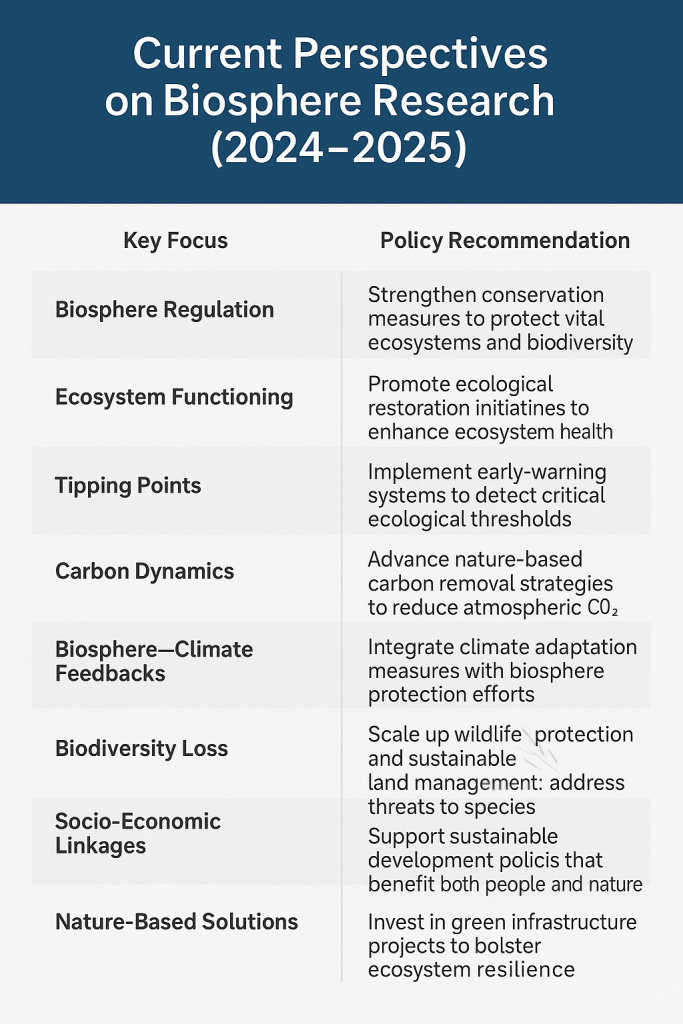
Biosphere Research Highlights 2024–2025
Conclusion: Biosphere Research as the Heart of Earth Stewardship
The biosphere is more than the sum of ecosystems; it is the pulse of the planet. The latest research from 2024 to 2025 urges a science-policy-practice synthesis. Whether through high-tech sensors or ancestral wisdom, the message is clear: We must value, protect, and partner with the biosphere.
Stay with Decoding Biosphere as we continue decoding the science, stories, and stewardship of the living Earth.
Subscribe to our updates or download our research-based infographics
#BiosphereResearch2025 #PlanetaryBoundaries #NatureBasedSolutions #DecodingBiosphere


 Decoding Biosphere