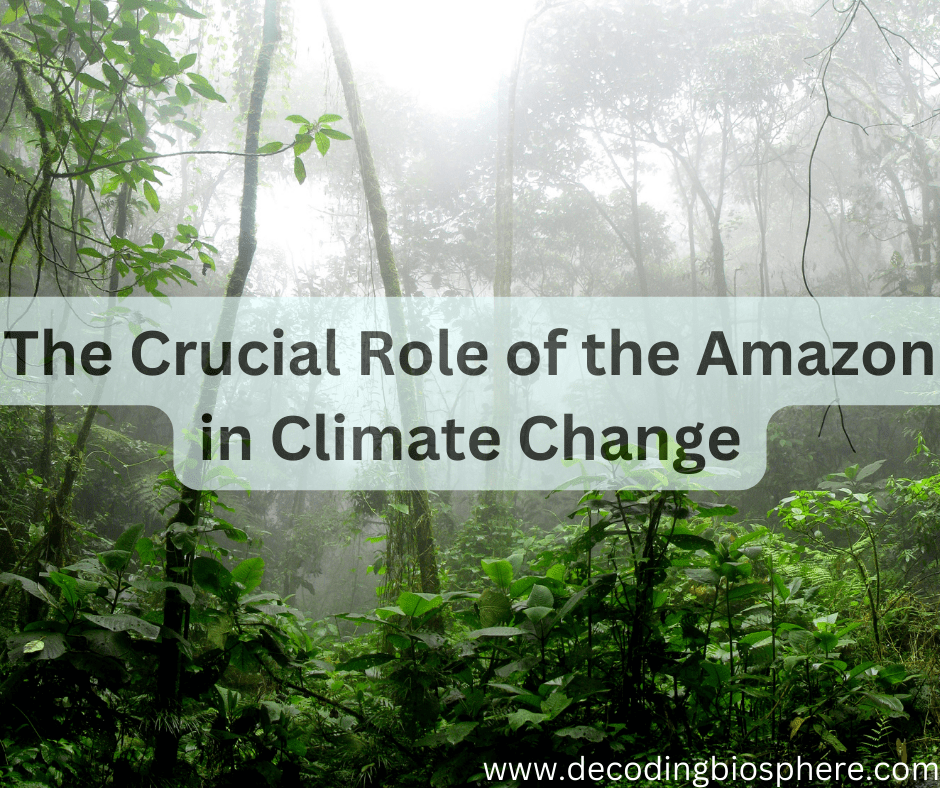
The Amazon rainforest in South America is not just a vast expanse of lush greenery—it’s a vital player in the battle against climate change. Its significance extends far beyond its remarkable biodiversity and breathtaking landscapes.
The sheer magnitude of the Amazon’s expanse—covering nearly seven million square kilometers, comparable to the area of Australia—elevates its significance on the global climate stage. Enveloped in an extensive canopy of trees, the Amazon wields an enormous influence on its surroundings. Some of its actions are nothing short of exceptional: the Amazon generates its own weather, contributes to its own rainfall, and maintains its temperature equilibrium, stabilizing regional climates. Combined with its massive storage of greenhouse gases in its biomass, the Amazon functions as a natural climate guardian.
Carbon Storage Giant:
The Amazon rainforest is a colossal carbon sink, meaning it absorbs more carbon dioxide (CO2) from the atmosphere than it releases. Through the process of photosynthesis, trees capture CO2 and store it in their biomass—their trunks, leaves, and roots. The Amazon’s unparalleled expanse of trees makes it one of the world’s largest natural carbon reservoirs. This stored carbon plays a crucial role in regulating Earth’s climate by reducing the concentration of CO2, a greenhouse gas responsible for global warming.
However, when human activities result in deforestation—clearing vast swaths of trees—the stored carbon is released back into the atmosphere as carbon dioxide (CO2), contributing to global warming. Deforestation, often carried out for agriculture and mining, has led to a 17 percent reduction in the Amazon’s tree cover since 1970.
Climate Regulation:
The Amazon rainforest is an atmospheric powerhouse, generating its own weather patterns. This phenomenon is known as “evapo-transpiration.” Trees release water vapor through a process called transpiration, which contributes to the formation of clouds. These clouds, in turn, reflect sunlight back into space, leading to cooling effects on regional temperatures. This process is analogous to how sweating cools the human body after exercise. By maintaining a balance of temperature and humidity, the Amazon helps stabilize regional and even global climates.
Rainfall Generation:
The Amazon plays a pivotal role in the hydrological cycle—how water circulates between the Earth’s surface and the atmosphere. Vast amounts of water are transpired by trees during the dry season, creating water vapor that rises into the atmosphere and forms clouds. These clouds release rainfall, which replenishes rivers and streams and supports diverse ecosystems. The Amazon’s hydrological cycle also influences weather patterns in regions beyond its borders, contributing to the overall global climate system.
Biodiversity and Ecosystem Services:
The Amazon rainforest is a biodiversity hotspot, home to an incredible array of plant and animal species. This rich biodiversity contributes to the resilience of ecosystems and enhances their ability to adapt to changing environmental conditions. The interconnectedness of species and ecosystems within the Amazon means that its preservation is essential for maintaining the delicate balance of nature and ensuring the provision of vital ecosystem services, such as pollination, water purification, and soil fertility.
Feedback Loop:
The Amazon’s health is intimately connected to climate stability. When the Amazon thrives, it supports a complex web of interactions that contribute to a balanced climate. However, when the Amazon is threatened by deforestation, degradation, or climate change impacts, it can trigger a dangerous feedback loop. For instance, higher temperatures and reduced rainfall can lead to forest dieback and increased vulnerability to wildfires, releasing stored carbon into the atmosphere and exacerbating global warming.
The Perils of Losing the Amazon
The potential consequences of losing the Amazon are staggering. If large-scale deforestation and degradation continue, the Amazon could transition from a lush rainforest to a savanna-like landscape. This transformation would release massive amounts of stored carbon back into the atmosphere, accelerating global warming. Furthermore, reduced rainfall and altered weather patterns could have far-reaching effects on regional climates and ecosystems, impacting agriculture, water availability, and biodiversity far beyond South America’s borders.
The Amazon’s immense carbon store—over 150 billion tons—equates to more than a decade’s worth of global fossil fuel emissions. Should the Amazon transform into a savanna-like landscape, regional rainfall may drop by up to 30 percent, impacting areas as distant as Colombia and Argentina. The absence of the forest’s cooling effect would lead to several degrees of regional temperature rise.
The Amazon rainforest is an irreplaceable ally in the fight against climate change. Its role as a carbon sink, climate regulator, and generator of rainfall makes it a cornerstone of global climate stability.
The fate of the Amazon isn’t confined to its distant shores—it resonates across the globe. The Amazon’s future is inseparable from the fate of our planet, emphasizing the critical importance of safeguarding this extraordinary biome for generations to come.
You may Also Like


 Decoding Biosphere