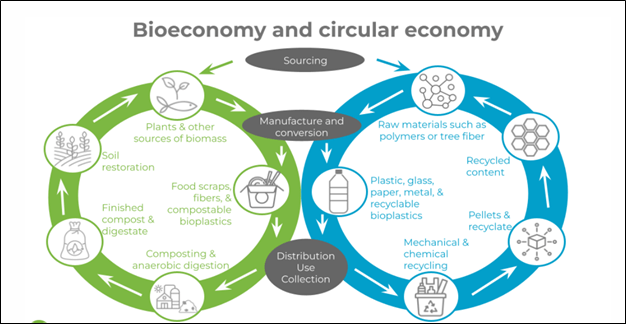
Bio-economy can be termed as circular economy’s twin, their concepts are very similar. The literal meaning of bio-economy is using renewable biological resources produced on land, sea and rivers for example plants, sea organisms, animals or micro-organisms to produce nutrition, textiles, and energy. Bio-economy can be defined as “an economy where the basic building blocks for materials, chemicals, and energy are derived from renewable biological resources.” The European Commission has worked on this concept very deeply and observed it to be a system in which society optimally uses renewable biological resources, such as those from land, fisheries, and aquaculture environments, to create food, bio-based products, nutrients, and bio-energy. A new New McKinsey Report states that the bio-economy is estimated to be worth 4 trillion in the year 2020. Bio-economy is not a novel concept. The concept is being used since the 1990s and extensively discussed in the 2002 book called “Cradle to Cradle: written by Wiliam McDonough and Michael Braungart. In the figure below, we see the cycles of bio-economy and circular economy are compared to each other.
Let us look at the examples of Bio-economy used as a business model with a simple and easy understanding.
The company called Dole in Philippines have a partnership with a budding business called Ananas Anam where they convert pineapple leaves into fibers to produce vegan leather called Piñatex. The startup is known to produce this vegan leather that prevents 825 tons of pineapple waste, that is conventionally burned creating CO2 emissions equivalent to 264 tons of carbon dioxide. Another step forward, Dole partnered with Musa Fabric a social enterprise turning banana pseudo-stem waste into textiles that are hand woven. Dole has taken the bio-economy to the next level by creating biogas from fruit waste. This is operated at their production facility center where the company is developing two biogas facilities. This innovative upcycling of food, packaging, fibers, and electricity, Dole and its partners have set an example to add value to fruits by working towards eliminating waste.
To explain bio-economy further, it is characterized by a strong interest in innovation through research and technology development, it has a defined structure, and is extensively interdisciplinary. It is clear that the concept of bio-economy needs complex knowledge contributed from different fields. It is certain that it needs a high degree of coordination between actors. Moreover, the invented technologies in this economy require to comply with complex policy rules and regulations that are rooted in various sectors.
Sustainability and bio-economy have a deep connection since concepts of bio-economy are inspired by nature. This strategy has become a great focus of attraction as a potential solution for green growth and competitiveness. The awareness of the sustainable development goals and the need to combat climate change has accelerated the applications of this strategy. Thus, natural resources present an opportunity for sustainable development in bio-based industries. In addition to this, there is the possibility for indefinite innovation and job creation in rural and industrial areas. It also adds up to the opportunities that rejuvenate productivity and development by improving the competency of local businesses through novel technologies thus decreasing dependence on imported raw materials acquired by unsustainable ways.
With respect to climate change, we are aware that there is an alarming necessity of making the production process and consumption patterns more sustainable, due to the increasing pressure on non-renewable resources. A shift is needed towards more sustainable production and more efficient use and management of bio-resources that will assist in reducing waste, pollution, climate change, and the use of fossil resources. This indicates that a transformative step is needed to imply an array of changes in primary production as well as industrial processes that are characterized as bio-economy.
To further elaborate, bio-economy is a strategy that exploits the complete potential of biotechnological research and innovation for the economy and society together. It has been elevated in the last twenty years, especially by countries that are experts in biotechnology like the Netherlands, Germany, and Finland. In the year 2006, the OECD organization prepared and submitted a major report “The Bio-economy 2030: Designing a policy agenda”. In the year 2012, the European Commission submitted the first bio-economy strategy. All bio-economy strategies aim to contribute to the economic growth and international competitiveness of the respective economic system. Additionally, some methods anticipate a rise in employment creation as a result of financial expansion. The promise of economic growth is also extended to traditional bio-economy industries by methods that define the bio-economy broadly. The objective of the economy taking a leading role in technological advancement is intimately related to economic expectations. All policy texts agree that the economy is being shaped by new scientific and technology breakthroughs and that these developments should be encouraged.
Reference:
- Lewandowski, I. ed., (2018). Bioeconomy. Cham: Springer International Publishing. doi:https://doi.org/10.1007/978-3-319-68152-8.


 Decoding Biosphere