Our planet is facing extreme degradation due to climate change and environmental pollution. Industrialization and modernization of societies have a great contribution to this situation. Overproduction and consumption of resources are one of major factors in polluting the planet without giving it a second thought. There should be a solution to this linear cycle of production and consumption.
A circular economy is the answer to this crisis. To understand the circular economy, let us first look at the linear economy. In the below picture, the linear economy moves in the forward direction where the resource is taken and made to be used and then disposed of which becomes a waste that accumulates in the environment causing environmental degradation. On the other hand, the circular economy moves forward but returns back to the resource step completing a circle, hence the concept is called circular in direction. This circular loop is a sign of being sustainable. In a nutshell, circular economy is opposite to the linear economy model.

There is an alarming need to combat climate change and environmental degradation and hence it is important that the common people understand the concept so crucial to help save the planet i.e. “The Circular economy”. Hence, we intend to talk about this concept to spread awareness and motivation among the readers.
what is circular economy
The circular economy begins with the consumption of natural resources and concludes with the production of non-recyclable waste. The fundamental principle of the circular economy is the recycling of manufactured products after their daily consumption and use. he circular economy is a model of production and consumption, which involves sharing, leasing, reusing, repairing, refurbishing, and recycling existing materials and products as long as possible. In this way, the life cycle of products is extended. The concept can be used on any product or consumables that we are using in a day-to-day basis. For example, the material and the resources to make a consumable can be recycled and introduced in the circular loop. Innovation is an important and crucial aspect in developing any circular loop with respect to the product. Major areas where circular economy is recently being used are: electronic and Electrical appliances, Plastic, glass and rubber products, fashion etc.
Researchers have come to study this concept and have applied and tested it in different fields, especially in combating environmental issues such as waste management, climate change, energy, air and water quality, land use, industry, food production, life cycle assessment, etc. There are many start-ups running on the concept of circular economy termed as “circular start-ups”. Let us look at the review of the report describing this circular startup:
- Circular start-ups are novel entrepreneurial ventures working in on the circular economy that is not yet been the focus of extensive research.
- These start-ups are extensively under-researched, circular startups could contribute excessively to an exponential transition to a better circular economy.
- Their findings showcase that, compared to large established firms, circular start-ups develop circularity strategies higher in the waste management hierarchy and engage in circular innovations that are often overlooked.
“Transitioning towards a more circular economy calls for disruptive innovation”
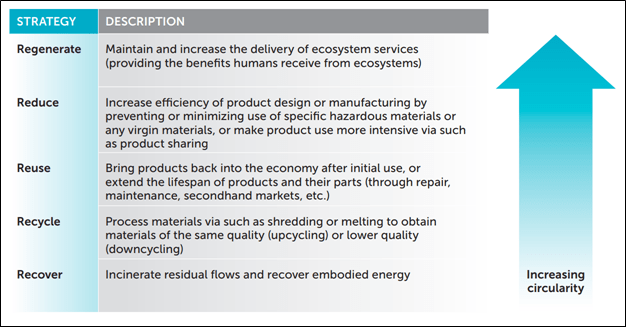
Following are four examples of circular startups that show that circular economy is not difficult to achieve, we should change our vision towards our production and consumption and be mindful of our mother Earth.
Rotterzwam
Rotterzwam- a circular start-up that manufactures oyster mushrooms from waste produced by coffee. It uses recycling as a circularity strategy, and thus combines multiple revenue streams. It distinguishes its model from other conventional companies. The Rotterzwam’s founder and CEO explained their plan “The business model is complex since we have multiple cashflows, which also differentiates us from ‘old economy’ companies, as we do not have a core business model.” In the first step, the company sells edible mushrooms grown from coffee grounds to local restaurants. After that, the company collects coffee waste from coffee-producing companies. Next, through e-learning and online courses, it trains entrepreneurs in other cities to create and run the same business model of growing mushrooms from coffee waste.
awareness
Dutch start up called as “awareness” is a textile company that manufactures workwear from 100% recycled polyester which is recycled up to eight times. The company rents the garments instead of selling them. A digital track-and-trace system is used to keep clothes in check. Thus, implementing and monitoring the company’s entire product chain. This ensures that all actors comply with circularity principles. Hence, while the company’s dominant strategy is Recycle, the innovations it develops include using a PSS model, implementing enabling technology (asset tracking), encouraging customers’ active involvement (via the return system) and setting circularity standards along its value chain.
BUNDLES — SMART LAUNDERING
Bundles is another very unique Circular start-up that provides washing machines as a service instead of selling them on a pay-per-wash basis. The start-up maintains the ownership of its appliances thus monitoring their usage with the help of a device that informs customers about statistics on consumption of energy, water, and detergent. Steps are provided to optimize the use of the machines, indirectly helping decrease economic and environmental costs and hazards and at the same time extending the life span of the appliance. Every time a machine is returned to Bundles, it is repaired or remanufactured and then rented to the next customer.
KARTENT — CAMPING IN A BOX
Disposing of plastic tents after single use is a common sight in Europe that then ends up in landfill or incinerated. Hence to prevent this situation, a start-up called KARTENT developed a tent made of high-quality waterproof cardboard, adopting a Reduce strategy. Recently, KarTent has expanded its reach to festivals in more than 19 countries to offer music fans the option to buy a cardboard tent when purchasing their tickets. The start-up has now replaced around 48,000 plastic tents. After each event, the tents are collected and transformed into cardboard boxes (Recycle strategy), which are then sold into the B2B market.
These were a couple of examples where the circular economy is used for running a sustainable business, but there are more such start-ups and innovative business models in the market. There are still many more such ideas that can be converted into successful businesses using circularity. Readers that are keen in the circular economy model can read about it in detail of research articles freely available in the literature.
Reference:
- Yang, M., Chen, L., Wang, J. et al. Circular economy strategies for combating climate change and other environmental issues. Environ Chem Lett 21, 55–80 (2023). https://doi.org/10.1007/s10311-022-01499-6.
- https://www.uu.nl/sites/default/files/disruptors_circular_start-ups_uu_e-version.pdf


 Decoding Biosphere
One thought on “The Circular Economy: A Sustainable Solution”