“Less is more” is a golden principle to practice sustainable consumption. Sustainable consumption and production is one of the global SDGs defined by the United Nations. It is goal No. 12 that explains the importance of producing and consuming goods and services provided by businesses in a sustainable manner. For example, our planet Earth is a source of abundant natural resources. But we fail to utilize them with responsibility and consume these resources far beyond the capacity of our planet’s abilities. It is a high necessity to start learning the proper and sustainable use and production of goods and services that will reverse the harm that we have inflicted on the planet.
Since the industrial revolution, man has had all the means of producing goods and services in a simple and effective manner. For example, the clothing industry has developed the technology and knowledge to produce clothes and garments efficiently in a given time. But due to the increase in population and the development of improved techniques of producing different goods, we, humans have gone beyond using the natural resources provided by the planet. Unsustainable patterns of consumption and production are the root causes of the triple planetary crises of climate change, biodiversity loss and pollution. There has been a report on a picture taken from the space of a massive pile of discarded clothes near Chile. It is a very disturbing truth about the amount of production and consumption our businesses are promoting through the hunger for profit and competition.
In a nutshell, sustainable consumption is simply the act of making mindful decisions and choices about the consumption, use, and disposal of products. There are two simple reasons for the need for sustainable production and consumption. First, the resources used on the planet are getting exhausted, and second, the unsustainable use of goods and services is eventually producing waste. Since the SDGs were published in the year 2015, businesses have been making efforts to work on a sustainable way of production. There is a statement given by Ethan Goffman Sponsor’s feature that states “Corporations need to look beyond making money as their primary goal and work towards both sustainable consumption and production.”
One of the greatest global challenges is to integrate environmental sustainability with economic growth and welfare by decoupling environmental degradation from economic growth and doing more with less. Resource decoupling and impact decoupling are needed to promote sustainable consumption and production patterns and to make the transition towards a greener and more socially inclusive global economy.
Let us look at the action and steps designed to achieve:
There are a few actions designed by the UN for businesses to take to achieve sustainable consumption and production:
- Adopting a circular model: Businesses can adopt circular economy principal in their business model to reduce the impact of the waste generated at the end of the life cycle of the product.
- Close Material and energy loop: On similar lines, as discussed in the point above, businesses should close their raw material supply loop by using the waste generated at the end of the life cycle. Same applies to the energy used in the operations of the businesses.
- Promote the use of resources that produce negligible waste and pollution: Businesses should promote and use the resources that are making the least harm to the environment and do not produce any waste after use.
- Conduct sustainability reporting: Businesses should make efforts to measure their operations based on sustainability criteria so that they can keep track of their impact on the environment.
These were the steps that businesses can apply and support sustainable consumption in their operations. Next, we look at the steps that a common man can take to achieve the consumption of goods and services in a sustainable way.
- The principle of the 3 Rs: Reduce, Reuse, and Recycle the consumption whenever possible. Opt for durable and long-lasting products, decrease single-use products, and separate recyclable materials for proper utilization.
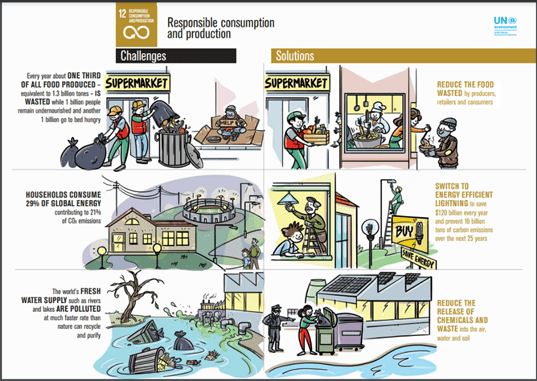
- Preserve Energy and Water: Always try to use energy-efficient appliances, turn off lights and electronics when not in use, and opt for renewable energy sources whenever possible. safe water by fixing leaks, applying water-efficient fixtures, and practicing responsible water use habits.
- Always choose Sustainable Products: Select and buy products from companies that prioritize sustainable practices and offer environmentally friendly products. Check for eco-labels and certifications that show a product’s sustainability credentials, like organic, Fair Trade, Forest Stewardship Council (FSC), or Energy Star labels etc.
- Minimize Food Waste: Plan your meals and buy only what you need and use them properly by storing and preserving food to minimize waste. Use your food waste in organic compost. Try to support local and sustainable food producers and choose products with minimal packaging.
- Take Sustainable Transportation: Reduce your carbon emissions by using public transportation, carpooling, biking, or even walking wherever possible. Select fuel-efficient vehicles or consider electric or hybrid vehicles.
- Support Circular Economy: Apply and embrace the concept of a circular economy by promoting initiatives that promote resource efficiency, waste reduction, and product reuse. Repair and refurbish items instead of discarding them. Buy second-hand or used goods where applicable.
- Engage in Sustainable Lifestyle Choices: Plan conscious decisions to adopt a more sustainable lifestyle overall. Including choices such as eating less meat, using eco-friendly personal care products, reducing plastic consumption, and supporting local and sustainable businesses.
- Promote Green Technologies: Embrace and support green technologies such as renewable energy, energy-efficient appliances, and smart home solutions. Stay informed about innovative solutions and advocate for their adoption in your community.
- Practice Responsible Tourism: When traveling, choose eco-friendly accommodations, engage in sustainable tourism activities, and respect the local culture and environment. Minimize your ecological footprint by conserving resources, supporting local businesses, and respecting wildlife and natural habitats.
- Support Sustainable Agriculture: Choose organic and locally grown produce whenever possible. Support farmers and suppliers who use sustainable farming practices, such as agroecology, permaculture, and regenerative agriculture. Reduce the use of chemical pesticides and fertilizers in your own gardening practices.
- Conscious Fashion Choices: Opt for sustainable and ethical fashion by choosing clothing made from eco-friendly materials, supporting fair trade and local artisans, and considering the longevity and durability of the garments. Avoid fast fashion trends and instead prioritize quality and timeless pieces.
- Practice Mindful Consumerism: Before making a purchase, consider the environmental and social impacts of the product. Ask yourself if you truly need the item and if there are more sustainable alternatives available. Avoid impulse buying and prioritize conscious consumerism.
References:
- https://blueprint.unglobalcompact.org/sdgs/sdg12/
- https://wedocs.unep.org/bitstream/handle/20.500.11822/25764/SDG12_Brief.pdf?sequence=1&isAllowed=y
- https://www.globalgoals.org/goals/12-responsible-consumption-and-production/
- https://audaces.com/en/blog/sustainable-consumption-production


 Decoding Biosphere
One thought on “Sustainable Consumption: What is in your hands?”