Today, the most crucial problem after climate change we face is Food security. Currently, the food produced globally is sufficient to feed every human being, but unfortunately, this produced food is not equally distributed. There are still more than 345 million people facing high levels of food insecurity in 2023.
The world population is growing exponentially and the need to achieve high food production is extremely important to keep pace with it. In the next coming years, it is estimated that agricultural emissions will increase by around 60% so that humanity can be supplied with food in appropriate quantity and quality. It is estimated that approximately 9 to 11 billion human population will be achieved by the year 2050. Unfortunately, the population number is disproportionate in terms of territorial distribution where the most population is based in urbanized environments rather than rural areas or farm lands. Scientific and technological innovations have been at its peak to solve the ever-growing demand for food production.
If current global development continues and population growth tendencies remain the same, there will be an addition of 2.4 billion people living in developing countries by 2050 (in South Asia and Sub-Saharan Africa, the population is expected to grow steadily). The size of urbanized areas is expected to increase threefold between 2000 and 2030. In these regions, agriculture is of outstanding national economic importance. To sum up, around 75% of the world’s poorest population live in rural areas, where agriculture is their livelihood. To give an estimation, on average, about 20% of the population living in rural areas is suffering from food supply security problems.
The current numbers and facts about food production confirm that conventional agriculture is not enough to feed a population that is constantly growing. Let us look at the highlights of some of the recent developments that have the potential to increase the production of food supply in a sustainable manner. Some of the known and popular ways of sustainable farming are vertical Farming/Agriculture, hydroponics and agroforestry, permaculture and biodynamic agriculture.
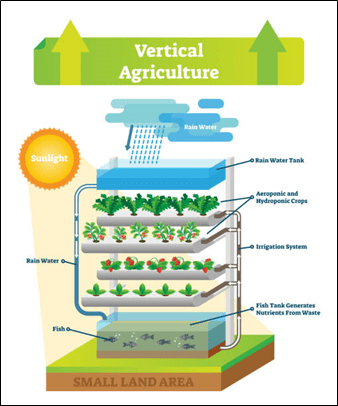
In vertical farming, there are six structural components used at optimal conditions for multilayered crop production. A hydroponic system provides mineral nutrients (N, P, K, Ca, Mg, S, Fe, Mn, Zn, B, Cu, Mo, and Si) to the roots of the plant through a stagnant aerated nutrient solution also known as a deep water culture, a continuous flow of nutrient solution by the use of nutrient film technique, alternating water levels, a nutrient mist (aeroponics), or by dripping the nutrient solution to individual plants (drip irrigation). This technique is used in urban areas where there is less space to grow any plantation. Businesses have been developed around this technology like the AeroFarms, Bright Farms, Sky Greens, etc around the world.
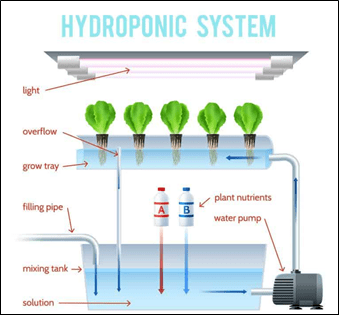
Hydroponic farming is another way of producing food crops in a limited area and nutrients. In this technique, plants are grown in water, not in soil. It may sound like it would be a complicated process, but it’s quite straightforward. Consider what a plant needs to grow: water, nutrients, air, light, space, and time. Hydroponic growing can meet all of these conditions by providing the big three macronutrients, known as NPK, or nitrogen, phosphorus, and potassium, along with other essential nutrients such as magnesium and calcium. These farms can grow a variety of food crops, but leafy green vegetables especially are grown the best in this way. This way, the plant puts its energy in growing its leaves more than on the root system.
In simple words, agroforestry is a way of practicing agriculture in the form of a forest. The crop plants are planted deliberately together with other native plants to the place. It is a term collectively used for land-use systems and technologies where woody perennial plants like trees, shrubs, palms, bamboo, etc. are a part of land-management units. Here the agricultural crops and/or animals, are arranged in some form of spatial arrangement or temporal sequence. In agroforestry systems, the ecological and economic interactions between the different components are allowed to take place.
Agroforestry is much more than just a way of farming, it is a dynamic, ecologically based, natural resource management system where the integration of trees on farms and in the agricultural landscape, diversifies and sustains production for increased social, economic, and environmental benefits for land users at all levels. Agroforestry is important for smallholder farmers and other rural people as it is able to improve their food supply, income, and health. This system is a multifunctional system that provides a wide variety of economic, sociocultural, and environmental advantages.
Permanent agriculture is somewhat similar to agroforestry and is defined as an integrated and progressive production system inspired by natural ecosystems. It is an ethical way of thinking and has a philosophy. It is developed around the principle of ‘the triple-win solutions’ which are taking care of the Earth, and the people and sharing resources effectively. It is termed together with vegetable cropping, gardening, and kitchen gardening.
The concept of permanent agriculture is a resilient, stable, and sustainable crop production system. The goal is to produce food without damaging soil while at the same time reducing waste. To be successful, the crops are selected according to different varieties and adapted to local conditions such as temperature, humidity, and soil. Permanent agriculture is a significant approach where it promotes biodiversity around and on the farmland. Farmers in this case are autonomous and self-sufficient by applying a low-energy system. Thus, with this kind of agriculture, it is possible to be productive and more efficient.
Biodynamics is a concept of farming defined to be the holistic, ecological, and ethical approach to farming, gardening, food, and nutrition. Biodynamics is based on the principle of the work of philosopher and scientist Dr. Rudolf Steiner. In 1924, Dr. Steiner taught farmers this principle that created a new way to integrate scientific understanding with a recognition of the spirit in nature. The evolution of Biodynamics began in the 1920s and has since been fueled by many farmers and researchers worldwide. The key factor for its spread around the world is its wide range of applications in almost all geographical regions. These are some of the sustainable ways that are being developed and used in businesses to produce food crops effectively. There are other innovations that are still in the pipeline to be used to effectively produce food crops. The readers can read more about other sustainable ways of producing food crops.
Reference:
- Fróna, D.; Szenderák, J.; Harangi-Rákos, M. The Challenge of Feeding the World. Sustainability 2019, 11, 5816. https://doi.org/10.3390/su11205816
- Lucia Tamburino, Giangiacomo Bravo, Yann Clough, Kimberly A. Nicholas, From population to production
- n: 50 years of scientific literature on how to feed the world, Global Food Security, Volume 24,2020, 100346, ISSN 2211-9124, https://doi.org/10.1016/j.gfs.2019.100346.
- Van Gerrewey, T.; Boon, N.; Geelen, D. Vertical Farming: The Only Way Is Up? Agronomy 2022, 12, 2. https://doi.org/10.3390/agronomy12010002
- http://www.istockphoto.com. (n.d.). 60+ Hydroponic Vertical Farm Illustrations, graphiques vectoriels libre de droits et Clip Art – iStock. Available at: https://www.istockphoto.com/fr/illustrations/hydroponic-vertical-farm
- Heather (2014). How to Get Started with Hydroponics – So Easy! [online] The Homesteading Hippy. Available at: https://thehomesteadinghippy.com/how-to-get-started-with-hydroponics/.


 Decoding Biosphere
One thought on “Food and Sustainability: Are we There Yet?”