Last Updated: February 2026
Water pollution affects biodiversity across the world by altering aquatic ecosystems, reducing species populations, and in severe cases, causing local or global extinctions. Biodiversity refers to the variety of life forms on Earth, including plants, animals, and microorganisms, and the interactions among them. When water bodies become polluted, these delicate interactions are disrupted, threatening ecosystem stability.
Some pollutants directly kill aquatic organisms, while others alter water chemistry, food availability, or oxygen levels. In many cases, species migrate away from polluted waters, while sensitive organisms disappear entirely, leading to long-term ecological imbalance.
In this article, we explore how different types of water pollution affect biodiversity, with real examples and ecological explanations.
Major Ways Water Pollution Impacts Biodiversity
Water pollution affects biodiversity through several interconnected mechanisms:
- Direct toxicity to aquatic organisms
- Habitat degradation and loss
- Disruption of food webs
- Oxygen depletion and dead zone formation
- Bioaccumulation of harmful substances
Even when pollution does not immediately kill organisms, it can alter behavior, reproduction, and survival rates, eventually reshaping entire ecosystems.
Effects of Nutrient Pollution (Nitrogen and Phosphorus)
One of the most widespread forms of water pollution comes from nutrient runoff, especially nitrogen and phosphorus from agricultural fertilizers and livestock waste.
These nutrients enter rivers, lakes, and groundwater when crops fail to absorb excess fertilizer. Globally, agriculture is a major contributor to nutrient pollution; in Europe, livestock farming alone accounts for nearly 73% of nutrient-driven water pollution.
Eutrophication and Dead Zones
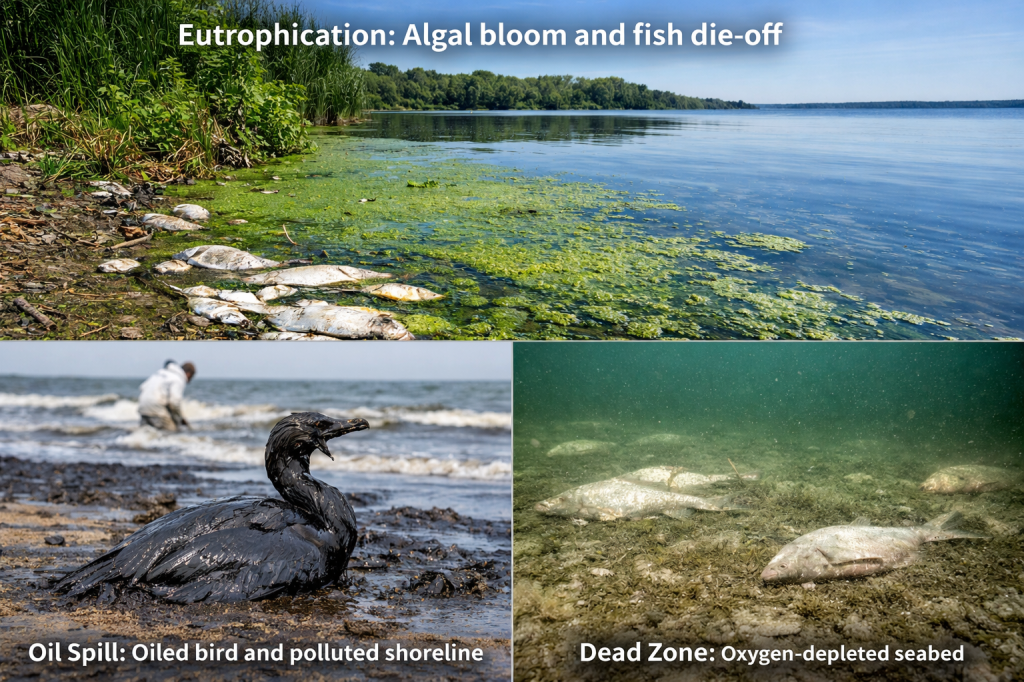
Excess nutrients cause rapid growth of aquatic plants and algae, a process known as eutrophication. While plant growth increases initially, the long-term effects are destructive:
- Algal blooms block sunlight
- Decomposing plant matter consumes oxygen
- Oxygen levels drop sharply at night
This creates hypoxic or “dead zone” conditions, where fish, crustaceans, and invertebrates cannot survive. In Asia, eutrophic lakes now account for over 50% of total lakes, severely reducing aquatic biodiversity.
Effects of Pesticides on Biodiversity
Pesticides used in agriculture and urban areas often reach water bodies through surface runoff and improper disposal.
Studies from the United States have shown that over 90% of water and fish samples contained at least one pesticide residue. While some pesticides do not cause immediate death, they can:
- Reduce growth and reproduction
- Impair swimming and feeding behavior
- Increase vulnerability to predators
In stagnant water bodies such as lakes and ponds, pesticides persist longer, making recovery difficult and biodiversity loss more severe.
Effects of Heavy Metals on Biodiversity
Heavy metals such as mercury, arsenic, cadmium, and lead enter water systems through mining, industrial discharge, automobiles, and cement production.
Unlike organic pollutants, heavy metals do not degrade easily. They accumulate in sediments and enter food chains through a process called bioaccumulation.
Effects include:
- Altered behavior in fish
- Reduced survival and reproduction
- Long-term toxicity in top predators
Over time, heavy metals reduce species richness and destabilize aquatic food webs.
Effects of Oil Pollution on Biodiversity
Oil pollution, particularly from large oil spills, has devastating impacts on biodiversity. While surface-dwelling birds and mammals show the most visible damage, deep-sea ecosystems often suffer long-lasting effects.
Oil affects organisms by:
- Blocking gills and airways, causing suffocation
- Damaging internal organs through toxicity
- Killing larvae and eggs
- Disrupting feeding and predator detection
Recovery from oil pollution can take decades, especially in cold or deep marine environments.
Effects of Acidification on Aquatic Life
When the pH of water drops below 5, it becomes acidic, often due to acid rain, industrial emissions, or mine drainage.
Acidic water:
- Kills plankton and algae
- Prevents shell formation in mollusks
- Stops coral reefs from building skeletons
- Reduces protein availability for fish
Coral reefs lose structure and color, while shellfish populations collapse, leading to major biodiversity loss.
Summary Table: Pollutants and Their Effects on Biodiversity
| Pollutant Type | Primary Effect on Biodiversity | Example Source |
|---|---|---|
| Nutrients (N, P) | Eutrophication, dead zones | Agricultural runoff |
| Pesticides | Toxicity, population decline | Farm & urban runoff |
| Heavy metals | Bioaccumulation, toxicity | Mining, industry |
| Oil | Habitat destruction | Oil spills |
| Acidification | Shellfish and coral mortality | Acid rain |
Why Biodiversity Loss from Water Pollution Matters
Biodiversity supports ecosystem services such as:
- Nutrient cycling
- Food production
- Climate regulation
- Water purification
Even the loss of a single species—especially keystone species—can destabilize entire ecosystems. While some species may recover after pollution is reduced, relying on natural recovery alone is risky and often insufficient.
Related Ecology Concepts
Habitat Fragmentation & Biodiversity Solutions
Impact of Climate Change on Biodiversity
Ecology Concepts (Food Webs / Keystone Species)
Frequently Asked Questions (FAQs)
❓ How does water pollution affect biodiversity?
Water pollution reduces biodiversity by killing aquatic organisms, degrading habitats, and disrupting food chains. Toxic chemicals, plastics, and excess nutrients can eliminate sensitive species and favor only pollution-tolerant organisms.
❓ What are the main sources of water pollution harming biodiversity?
Major sources include industrial effluents, agricultural runoff (fertilizers and pesticides), sewage discharge, plastic waste, oil spills, and mining activities. These pollutants alter water chemistry and damage ecosystems.
❓ How does eutrophication impact aquatic biodiversity?
Eutrophication occurs when excess nutrients cause algal blooms that block sunlight and reduce oxygen levels. This leads to fish kills, loss of plant life, and a sharp decline in species diversity.
❓ Can water pollution affect terrestrial biodiversity?
Yes. Polluted water affects terrestrial ecosystems through contaminated soil, poisoned food chains, and reduced availability of clean water for wildlife, plants, and humans.
❓ Which aquatic organisms are most sensitive to water pollution?
Fish, amphibians, plankton, benthic invertebrates, and coral reefs are highly sensitive. Amphibians are especially vulnerable because they absorb pollutants through their skin.
❓ How does plastic pollution affect biodiversity?
Plastic pollution causes entanglement, ingestion, and habitat damage. Microplastics enter food webs, affecting organisms from plankton to top predators and reducing reproductive success.
❓ Is water pollution reversible for biodiversity recovery?
In many cases, yes. Reducing pollution sources, restoring habitats, and enforcing environmental regulations can allow ecosystems to recover, although some damage may be long-term or irreversible.
❓ What can be done to reduce water pollution and protect biodiversity?
Key actions include proper waste treatment, sustainable agriculture, reducing plastic use, enforcing pollution laws, protecting wetlands, and promoting public awareness and conservation practices.
❓ How does water pollution affect biodiversity hotspots?
Biodiversity hotspots near rivers, wetlands, and coastal zones are highly vulnerable. Pollution in these areas can cause rapid species loss and ecosystem collapse due to already high ecological pressure.
Subscribe
Subscribe to get exclusive updates in our weekly newsletter!
Follow us on twitter @DecodingBiosph1


 Decoding Biosphere
2 thoughts on “How Does Water Pollution Affect Biodiversity?”